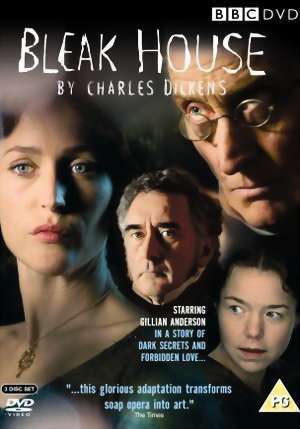
This evening we finished watching the BBC/A & E version of Charles Dickens' "Bleak House", which came out in 2005. Had actually watched it before when shown on TV, but decided to watch again on DVD. Excellent production, put together in 15 segments, the first was one hour, and the rest were each a half hour. One thing we realized, though, was that the DVD trimmed at least one scene that we had seen in the TV broadcast, so that wasn't good. Very much a Dickens story, with good and bad characters, tangled plotlines that involve everyone, with lies and secrets and murder, love and death, illegitimacy, greed, and dark humor. The whole court muddle concerning Jarndyce and Jarndyce case was so interesting in itself. Well cast, with Gillian Anderson playing Lady Dedlock, Anna Maxwell Martin, Patrick Kennedy, Denis Lawson, Charles Dance (great villainous lawyer), and Carey Mulligan playing the principals. And Pauline Collins was wonderful as Miss Flite. Very enjoyable production, and worth watching again.
Sunday, May 31, 2009
Finished 5/31/09:
LAVINIA by Ursula K. Le Guin, 2008.
Historical novel about the Latium princess Lavinia who was written about by Vergil in the Aeneid. She married the Trojan invader Aeneas and founded what became the Roman Empire. Well researched and written, although at times I felt it a bit slow. Author does a good job in her descriptions of what life was like in Italy then, its primitiveness, customs, daily life, culture, geography, and different tribes living in close proximity.
LAVINIA by Ursula K. Le Guin, 2008.
Historical novel about the Latium princess Lavinia who was written about by Vergil in the Aeneid. She married the Trojan invader Aeneas and founded what became the Roman Empire. Well researched and written, although at times I felt it a bit slow. Author does a good job in her descriptions of what life was like in Italy then, its primitiveness, customs, daily life, culture, geography, and different tribes living in close proximity.
Sunday, May 24, 2009
Finished 5/24/09:
THE SERPENT'S TALE by Ariana Franklin, 2008.
Second in the series of novels about Vesuvia Adelia Aguilar, the mistress of the art of death, this time concerning the poisoning of Rosamund Clifford, mistress of Henry II. Adelia is drawn into the mystery by her lover Bishop Rowley, and it falls to her to discover the culprit. Was it Eleanor of Aquitaine, Henry's queen, or someone she hired to do the deed? Or someone else? Snowstorms, assorted odd characters all trapped and isolated inside Godstow Abbey, more murders, spies, and intrigue, make for a bizarre and thrilling story.
THE SERPENT'S TALE by Ariana Franklin, 2008.
Second in the series of novels about Vesuvia Adelia Aguilar, the mistress of the art of death, this time concerning the poisoning of Rosamund Clifford, mistress of Henry II. Adelia is drawn into the mystery by her lover Bishop Rowley, and it falls to her to discover the culprit. Was it Eleanor of Aquitaine, Henry's queen, or someone she hired to do the deed? Or someone else? Snowstorms, assorted odd characters all trapped and isolated inside Godstow Abbey, more murders, spies, and intrigue, make for a bizarre and thrilling story.
Finished on 5/11/09:
SHADOW VALLEY by Steven Barnes, 2009.
Novel set in prehistoric Africa, follows tribal wanderings of the Ibandi, led by heroine T'Cori, the Great Sky Woman. It is up to her to lead her peaceful people away from their enemies and into a land of peace and plenty near Mt. Kilimanjaro. Interesting, plenty of violence and action, details of tribal life in Africa 30,000 years ago. A good read, something different for me in terms of time period and locale.
SHADOW VALLEY by Steven Barnes, 2009.
Novel set in prehistoric Africa, follows tribal wanderings of the Ibandi, led by heroine T'Cori, the Great Sky Woman. It is up to her to lead her peaceful people away from their enemies and into a land of peace and plenty near Mt. Kilimanjaro. Interesting, plenty of violence and action, details of tribal life in Africa 30,000 years ago. A good read, something different for me in terms of time period and locale.
Tuesday, April 28, 2009

Finished reading on 4/22/09:
MICHAL, by Jill Eileen Smith, 2009.
I read this in order to write a review for the Historical Novel Society, but I wanted to read it anyway, as I enjoy historical fiction concerning King David and his wives. Have read quite a bit of it by this point in my life, and found this to be an enjoyable story. The author did a good job in her portrayal of Michal and David especially--it showed the struggles Michal faced in being loyal to her family, to David, to her faith in God, and to herself. Even though she at times turned away from God, and against David, she redeemed herself and made peace with her inner turmoils, and her faith in God grew stronger for her troubles. David is shown as being charismatic, courageous, caring, and heroic, as he slays Goliath, keeps himself out of Saul's clutches, and remains a friend to Jonathan. This isn't a preachy book, but a gentle one. Good, accurate historical details, good characterization, fleshes out the Biblical passages from Samuel without straying from the traditional stories.
Tuesday, April 14, 2009
Finished on 4/10/09:
THE RIVER WIFE by Jonis Agee, 2007.
An unusual historical novel set in Missouri, along the Mississippi River. Jacques Ducharme, who rescued Annie Lark during the New Madrid earthquake of 1811, married her, and then founded the family, was a fur trapper and river pirate. His influence lasts well into the next century, as Hedie Rails, married to Jacques' descendant, Clement Ducharme, discovers in Annie's family journals. Misunderstandings, family secrets, infidelity, betrayal, horrific violence, paranormal experiences, and seduction play out the drama. Lots of period detail concerning life on the Mississippi, pirating, farming, horse breeding, etc. Worthwhile, if a little on the peculiar side.
THE RIVER WIFE by Jonis Agee, 2007.
An unusual historical novel set in Missouri, along the Mississippi River. Jacques Ducharme, who rescued Annie Lark during the New Madrid earthquake of 1811, married her, and then founded the family, was a fur trapper and river pirate. His influence lasts well into the next century, as Hedie Rails, married to Jacques' descendant, Clement Ducharme, discovers in Annie's family journals. Misunderstandings, family secrets, infidelity, betrayal, horrific violence, paranormal experiences, and seduction play out the drama. Lots of period detail concerning life on the Mississippi, pirating, farming, horse breeding, etc. Worthwhile, if a little on the peculiar side.
Tuesday, April 7, 2009

So I've now watched all of the first season's episodes of "The Tudors" on DVD, and while I found many errors and inaccuracies in the whole thing, I was still entertained by it and felt compelled to keep watching. I don't know why, as I was so frustrated over many things. SPOILERS HERE
It didn't seem as though much time passed in the story, although historically YEARS went by during the King's Great Matter. The make-up people didn't have Henry VIII age much, nor Anne Boleyn, nor many of the other characters, except poor Katharine of Aragon. The whole deal with combining Henry's sisters Mary and Margaret into one character, Princess Margaret, having her marry the old King of Portugal, then murder him (by smothering him with a pillow!), marrying Brandon, and then having her die several episodes later with consumption (throwing up huge gouts of blood, no less) was insulting and preposterous. Wolsey's committing suicide by cutting his own throat was outrageous and awful. Some characters had no point to the story--Thomas Tallis anyone? The power-hungry Duke of Norfolk seems to be less powerful here than usually portrayed and Thomas Boleyn much more of a dynamic aggressor. Henry Fitzroy did not die as a mere child of plague; Bessie Blount was not married when she was Henry's mistress, nor was she LADY Blount--she got a husband as a gift from Henry after he was finished with her and she was a commoner when Henry's mistress; Charles Brandon's ward was Catherine Willoughby--not Brooke--so many unnecessary changes and inaccurate things and general silliness. And those who don't know any better will believe it all.
That being said, I found it kept my attention, it was compelling drama, well staged, pleasant sets and costumes (although some of the women's headdresses were questionable), and some of the performances were very watchable. Sam Neill is very good as Wolsey; Jeremy Northam an interesting Sir Thomas More; Maria Doyle Kennedy is excellent as Katharine; Henry Cavill a boisterous and thrilling Brandon; and Jonathan Rhys Meyers gives a fine portrayal of a young, athletic, sexually charged Henry VIII. This whole series is definitely meant to appeal to a younger, edgier sort of audience. But couldn't it all have been done more accurately and still been just as dramatic and exciting? These people led such interesting and drama filled lives as it was, why does TV need to create/change/disregard history?
It didn't seem as though much time passed in the story, although historically YEARS went by during the King's Great Matter. The make-up people didn't have Henry VIII age much, nor Anne Boleyn, nor many of the other characters, except poor Katharine of Aragon. The whole deal with combining Henry's sisters Mary and Margaret into one character, Princess Margaret, having her marry the old King of Portugal, then murder him (by smothering him with a pillow!), marrying Brandon, and then having her die several episodes later with consumption (throwing up huge gouts of blood, no less) was insulting and preposterous. Wolsey's committing suicide by cutting his own throat was outrageous and awful. Some characters had no point to the story--Thomas Tallis anyone? The power-hungry Duke of Norfolk seems to be less powerful here than usually portrayed and Thomas Boleyn much more of a dynamic aggressor. Henry Fitzroy did not die as a mere child of plague; Bessie Blount was not married when she was Henry's mistress, nor was she LADY Blount--she got a husband as a gift from Henry after he was finished with her and she was a commoner when Henry's mistress; Charles Brandon's ward was Catherine Willoughby--not Brooke--so many unnecessary changes and inaccurate things and general silliness. And those who don't know any better will believe it all.
That being said, I found it kept my attention, it was compelling drama, well staged, pleasant sets and costumes (although some of the women's headdresses were questionable), and some of the performances were very watchable. Sam Neill is very good as Wolsey; Jeremy Northam an interesting Sir Thomas More; Maria Doyle Kennedy is excellent as Katharine; Henry Cavill a boisterous and thrilling Brandon; and Jonathan Rhys Meyers gives a fine portrayal of a young, athletic, sexually charged Henry VIII. This whole series is definitely meant to appeal to a younger, edgier sort of audience. But couldn't it all have been done more accurately and still been just as dramatic and exciting? These people led such interesting and drama filled lives as it was, why does TV need to create/change/disregard history?
Subscribe to:
Posts (Atom)